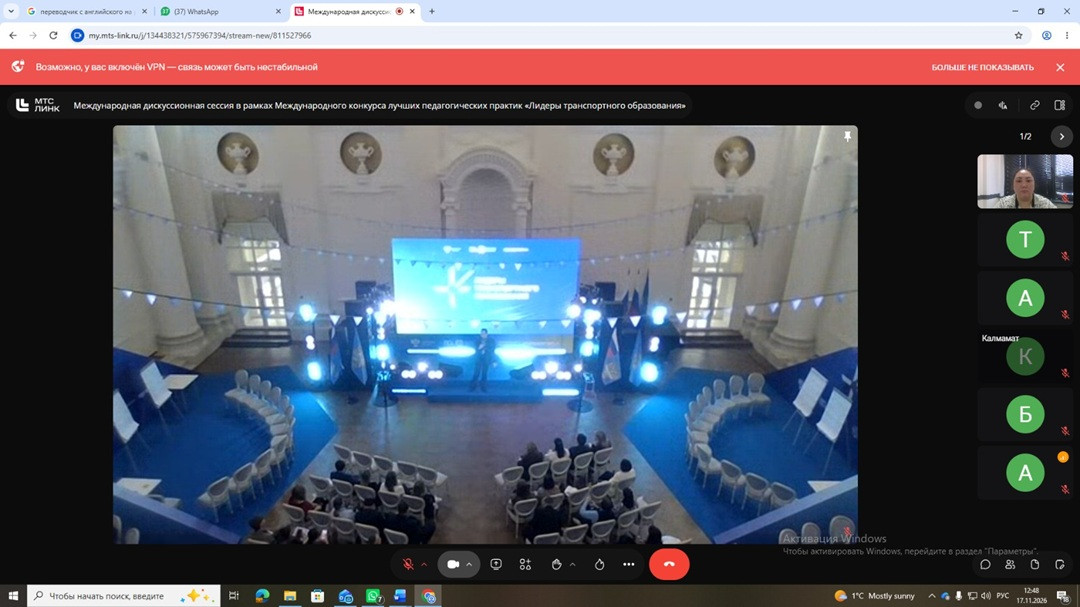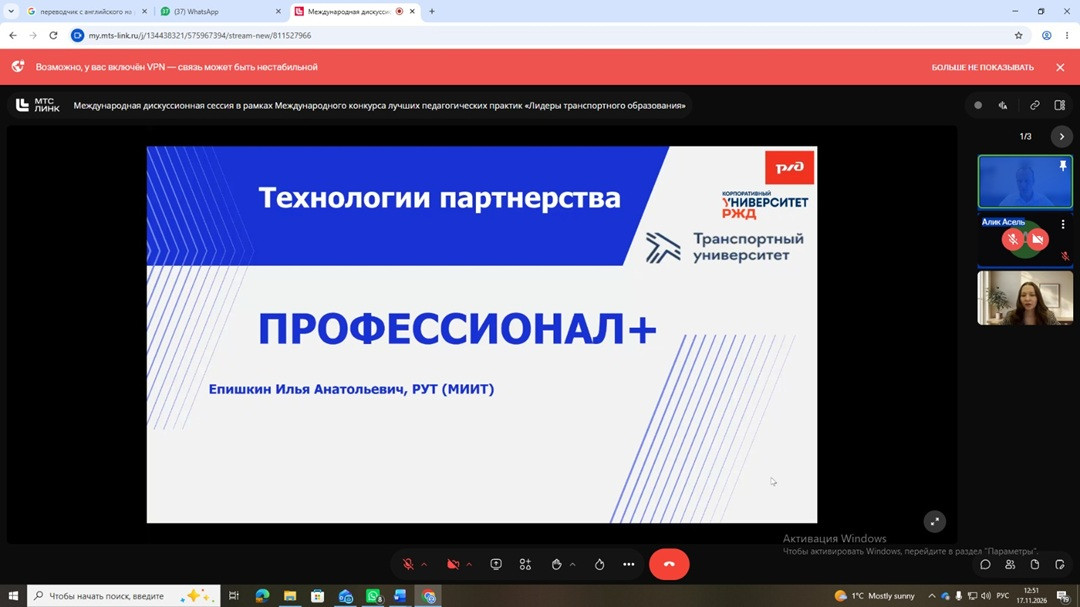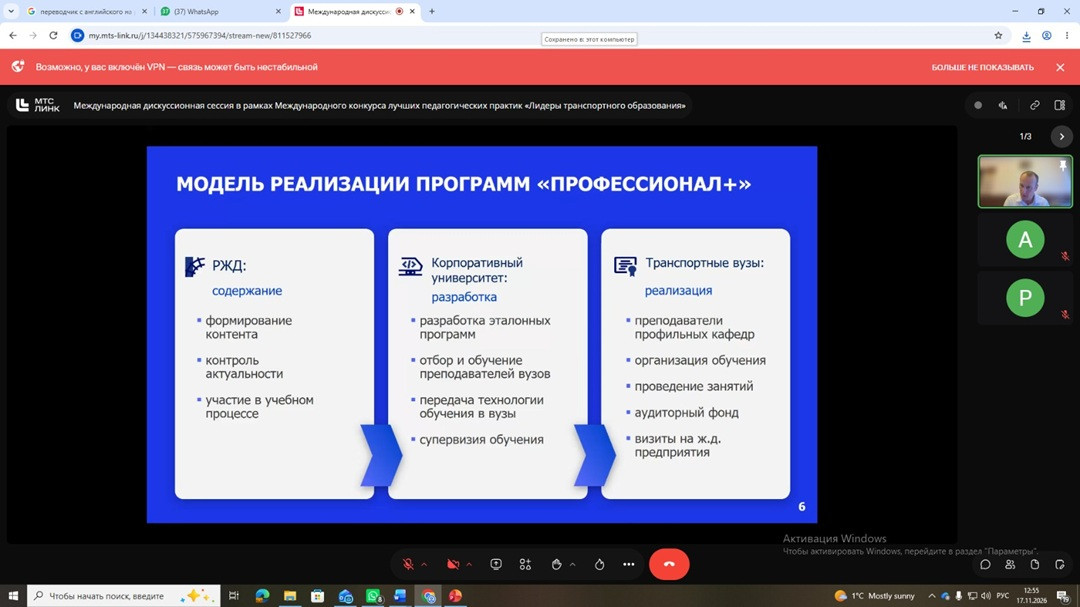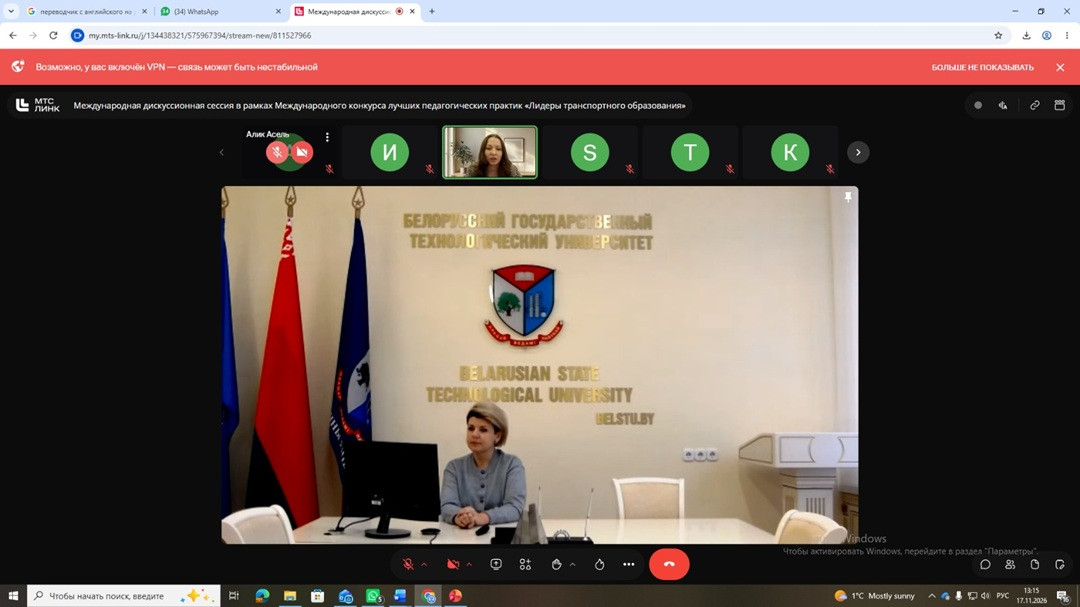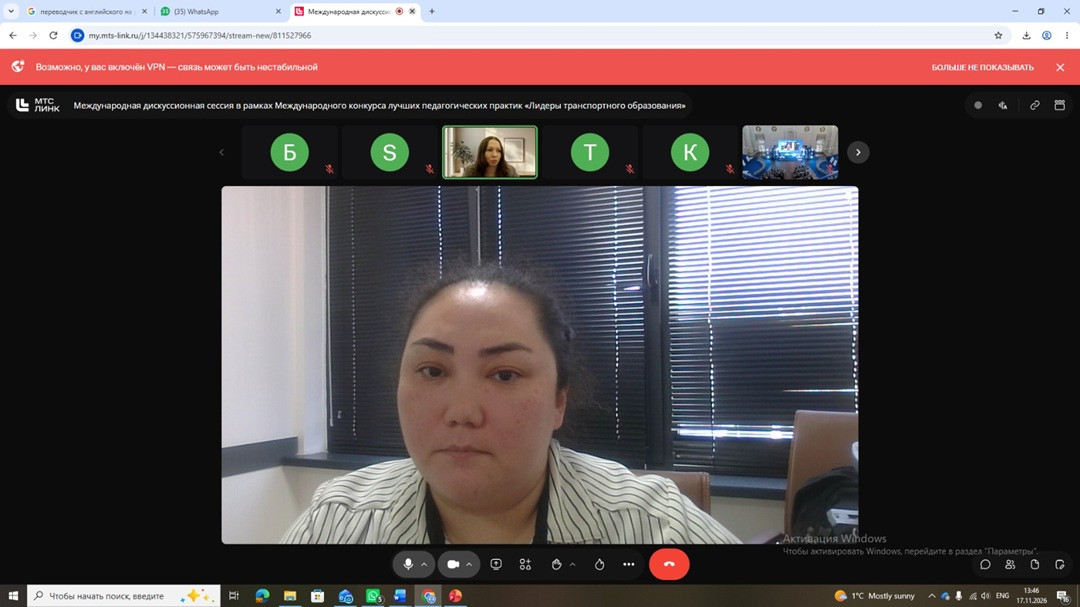
On November 17, 2026, Assel Rysbekovna Alik, Senior Lecturer at the Department of Logistics and Business, ALT University named after Mukhamedzhan Tynyshpayev, represented the university at an international discussion held as part of the International Competition of Best Teaching Practices “Leaders in Transport Education.”
The event took place at the Russian University of Transport (RUT (MIIT)) in Moscow in a hybrid format, bringing together representatives of educational institutions from different countries to exchange experience in training transport industry professionals.
Gamification as a Tool for Developing Analytical Thinking
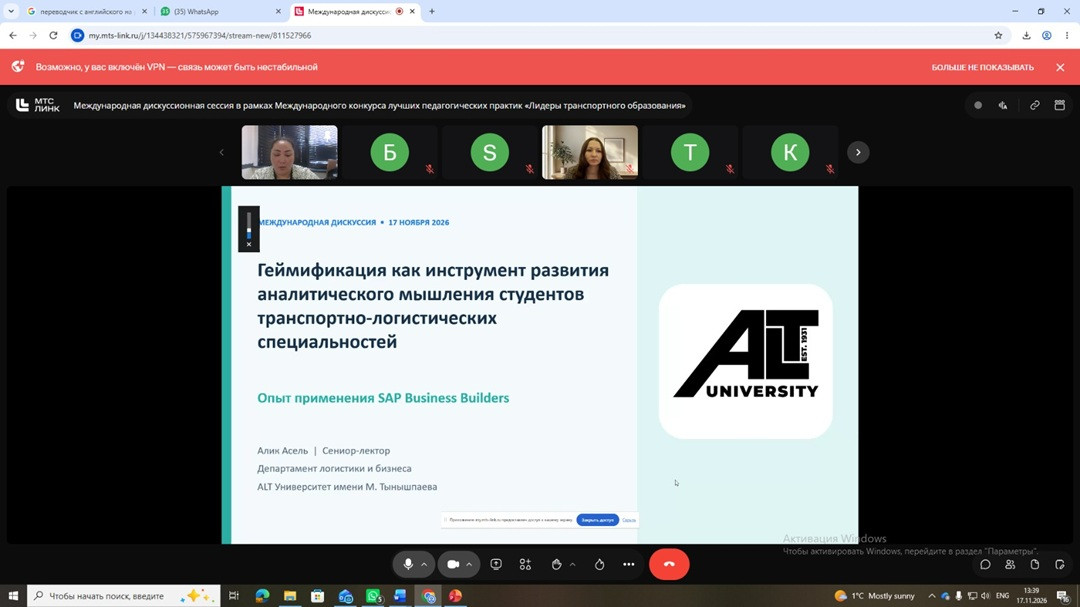
During the international discussion, Assel Alik delivered a presentation entitled “Gamification as a Tool for Developing Analytical Thinking among Transport and Logistics Students: Experience with SAP Business Builders.”
The presentation focused on modern approaches to practice-oriented education using digital learning tools and game-based technologies.
Particular attention was given to developing students’ analytical thinking, their ability to interpret data, identify relationships between performance indicators, and make well-founded management decisions.
The presentation emphasized that theoretical knowledge alone is no longer sufficient for modern transport and logistics professionals. The ability to analyze real business situations, evaluate alternative solutions, and justify decisions is equally important.
The Digital Learning Environment of the Department of Logistics and Business
The presentation highlighted ALT University’s experience in integrating modern digital technologies into the educational process.
In particular, the following tools and educational resources were presented:
-
AnyLogic — simulation modeling of transport and logistics processes;
-
Rail-Tariff — studying railway tariff calculations and transportation costs;
-
JD.com Training Laboratory — practical experience with semi-automated warehouse processes, modern equipment, and AGV robots;
-
SAP University Alliances — the university’s participation in SAP’s international academic network and access to its educational resources;
-
SAP Business Builders — developing skills in business performance analysis and decision-making through game-based scenarios.
It was emphasized that combining digital simulation, analytical tools, and hands-on experience with equipment enables a comprehensive approach to preparing future professionals.
SAP Business Builders: From Data Analysis to Decision-Making
The central part of the presentation focused on the experience of using SAP Business Builders, an educational game-based platform associated with ERPsim Lab at HEC Montréal and the SAP ecosystem.
The platform enables students to work with business data, analyze performance indicators, complete assignments, and receive feedback in an interactive environment.
As a practical example, the presentation demonstrated ALT University students’ experience with The Maple Heir — Financial Statements, a scenario designed to develop an understanding of financial reporting and data-driven business decision-making.
Although the scenario does not directly simulate transport operations, it helps students develop transferable analytical skills essential for future logistics professionals when evaluating transportation costs, operational efficiency, and business financial performance.
Special attention was given to the following learning process:
Problem Identification → Data Analysis → Comparison of Alternatives → Decision-Making → Justification of Results.
This approach aims to develop students’ ability not only to identify the correct answer but also to explain the reasoning behind their decisions.
International Exchange of Teaching Practices
The international discussion “Leaders in Transport Education” brought together presentations by representatives of transport and technical universities, addressing modern teaching methodologies, digital technologies, professional competency development, and improvements in transport education.
ALT University’s participation provided an opportunity to present its experience in integrating digital tools into teaching and to identify promising directions for the further development of practice-oriented education.
The exchange of pedagogical approaches among universities from different countries is particularly valuable for improving educational programmes and strengthening international academic cooperation.
Prospects for the Development of Digital Education
In her presentation, Assel Alik emphasized that gamification should not be regarded as an end in itself but rather as a pedagogical tool designed to develop specific professional competencies.
A promising direction for further development is the integration of game-based analytical scenarios with industry-specific case studies, simulation modeling, and laboratory practice.
This approach will help establish stronger connections among theoretical knowledge, digital analytics, and real transport and logistics processes.
Presenting ALT University’s experience at an international forum reflects the university’s commitment to introducing modern educational technologies, developing students’ analytical competencies, and strengthening international professional cooperation.
Contribution to the United Nations Sustainable Development Goals
SDG 4 — Quality Education. Developing innovative educational technologies, digital competencies, and practice-oriented teaching methods aimed at improving the quality of transport and logistics education.
SDG 8 — Decent Work and Economic Growth. Developing analytical thinking, evidence-based decision-making skills, and professional competencies required in today’s digital economy.
SDG 17 — Partnerships for the Goals. Promoting international academic cooperation, exchanging best teaching practices, and strengthening collaboration among educational institutions from different countries.
ALT University’s participation in the international discussion “Leaders in Transport Education” provided an opportunity to share its practical experience in digital education and highlight the importance of preparing a new generation of professionals capable of working effectively with data and making informed decisions in the modern transport and logistics industry.
Author: Alik Asel