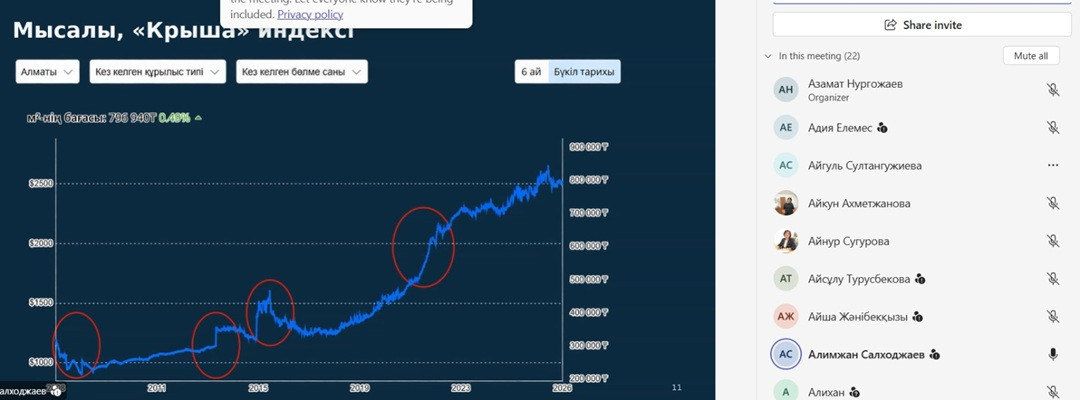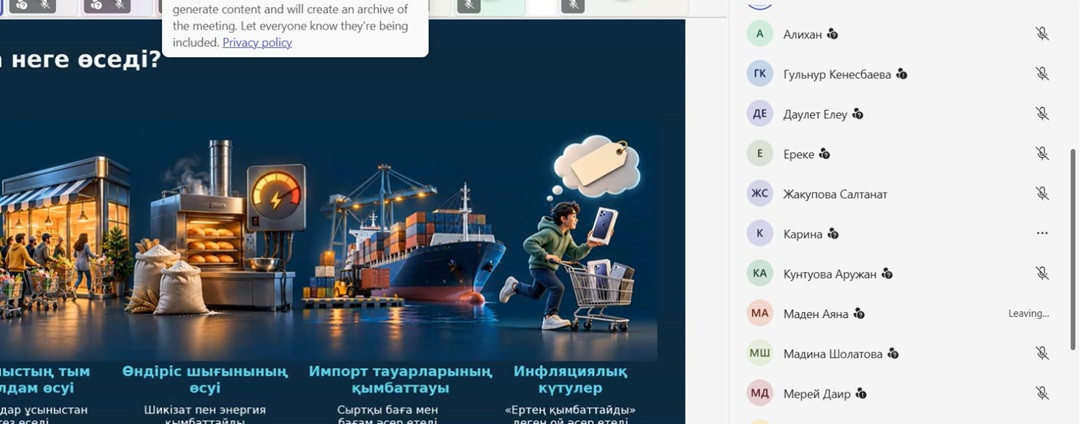
On November 2, 2026, ALT University hosted an online guest lecture entitled “Government Regulation of Inflation,” featuring a representative of the National Bank of the Republic of Kazakhstan.
The invited speaker was Alimzhan Islamkhanovich Salkhodzhayev, Deputy Director of the Monetary Policy Department of the National Bank of the Republic of Kazakhstan.
The event was organized by Azamat Serikovich Nurgozhayev, Senior Lecturer at the Department of Logistics and Business, ALT University.
The lecture was held via Microsoft Teams for students and academic staff of the Department of Logistics and Business at ALT University. It addressed one of the most pressing challenges facing the modern economy: inflation and the mechanisms of government regulation.
Inflation and Its Impact on the Economy
The central focus of the lecture was the government regulation of inflationary processes and the importance of monetary policy in ensuring macroeconomic stability.
Key issues associated with this topic include the causes of inflation and its effects on purchasing power, the cost of goods and services, business operations, and investment decisions.
Understanding these processes is particularly important for future professionals in economics and management, as changes in price levels and financing costs directly affect organizational planning, budgeting, and operational efficiency.
Monetary Policy as an Instrument of Inflation Regulation
An essential aspect of this topic is the role of the National Bank of Kazakhstan in maintaining price stability.
Monetary policy instruments, including the base interest rate, influence borrowing costs, saving behavior, and aggregate demand in the economy.
For students, understanding these mechanisms provides a foundation for recognizing the relationships among inflation, interest rates, financial markets, and the country’s economic development.
From Academic Knowledge to Professional Understanding of Economics
The involvement of a National Bank representative in the educational process helps connect students’ theoretical knowledge with real-world challenges of government economic regulation.
Such guest lectures are particularly valuable because they offer opportunities to examine economic processes from the perspective of professionals working in the financial sector.
Exploring the practical aspects of monetary policy contributes to the development of economic thinking, financial literacy, and the ability to analyze macroeconomic factors affecting businesses and organizations.
For academic staff, such meetings also provide valuable opportunities for professional development and for updating course content in line with current economic developments and government regulatory practices.
For ALT University, these events are an important component of practice-oriented education, aimed at preparing professionals who can understand contemporary economic challenges and make well-informed professional decisions.
Significance for the University and Participants
Guest lectures involving representatives of public financial institutions expand opportunities for professional education, facilitate knowledge exchange, and strengthen cooperation between academia and professional communities.
For students, such events offer an opportunity to explore current issues affecting the national economy, gain a deeper understanding of financial institutions, and recognize the practical relevance of the economic disciplines they study.
For academic staff, participation supports professional development, the exchange of expertise, and the integration of practical perspectives into teaching.
The online format enabled students and academic staff to engage directly with relevant professional topics and gain insights into the experience of a representative of the National Bank of Kazakhstan.
Contribution to the United Nations Sustainable Development Goals
SDG 4 — Quality Education. Enhancing practice-oriented education and developing financial literacy, economic thinking, and professional competencies among students and academic staff.
SDG 8 — Decent Work and Economic Growth. Promoting an understanding of macroeconomic stability, inflationary processes, and the role of monetary policy in supporting sustainable economic development.
SDG 17 — Partnerships for the Goals. Strengthening cooperation between the university and public financial institutions, facilitating professional knowledge exchange, and expanding opportunities for educational collaboration.
Guest lectures of this kind help students develop a systematic understanding of economic processes, support the professional growth of academic staff, and strengthen the connection between university education and the practice of government financial regulation.
Author: Alik Asel