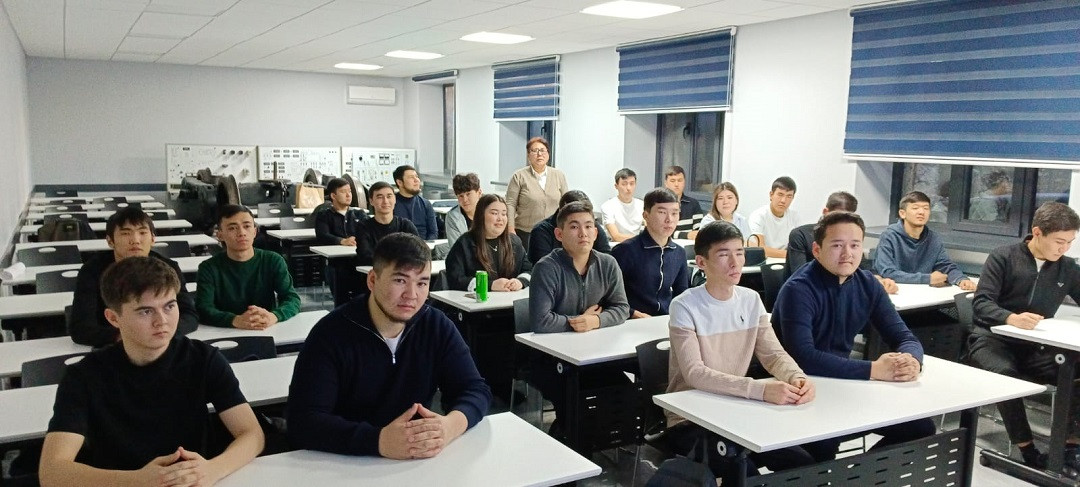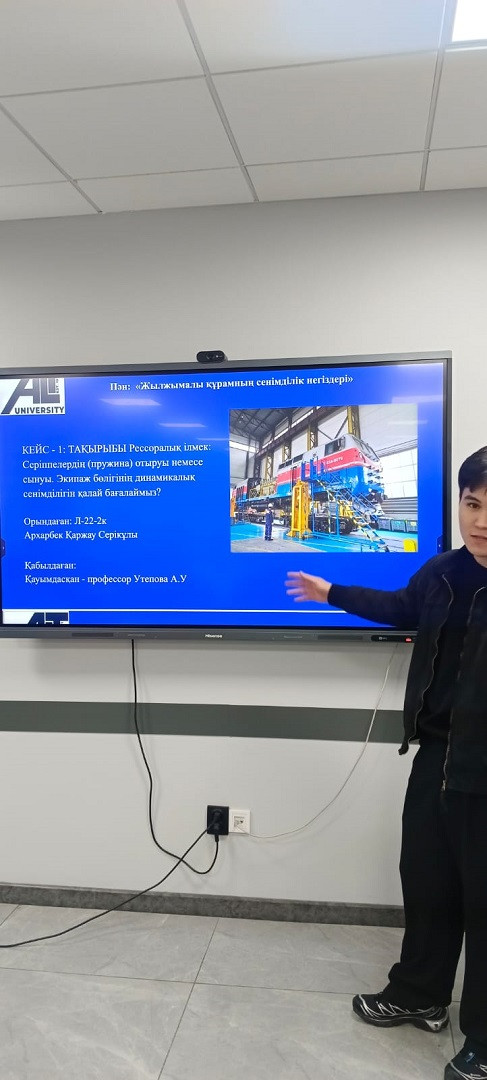
On December 22, 2025, Associate Professor A. U. Utepova of the ALT Department of Rolling Stock conducted an exam in the course Fundamentals of Rolling Stock Reliability for students enrolled in the educational programs 6B07117 — Locomotives, 6B07116 — Railway Cars, and 6B07137 — Rolling Stock Engineering (groups L-22-1,2; US-IPS-T, E, V — groups 1,2,3).
The course aims to train students in managing the technical condition of railway transport, preventing failures, and improving the operational efficiency of locomotives and railway cars.
The purpose of completing and defending the case assignments was to develop professional engineering thinking through the practical application of core concepts and indicators of reliability theory, analysis of failure causes and patterns in rolling stock, principles of component redundancy and storage, fundamentals of technical diagnostics, and organizational measures for ensuring reliability within maintenance and repair systems. These aspects were considered through the prism of sustainable development and reliability of transport systems.
Case assignments in the course Fundamentals of Rolling Stock Reliability proved to be an effective way of applying theoretical knowledge to real-world engineering problems. Students analyzed failures in locomotive and railcar components, evaluated reliability indicators, assessed the technical condition of rolling stock, identified cause-and-effect relationships of malfunctions, and proposed engineering solutions aimed at improving reliability.
The case assignments were submitted orally (in Word or PDF format) or in the form of presentations. Successful completion required adherence to a defined analytical structure. Particular attention was given to developing a deep understanding of the connection between the Sustainable Development Goals (SDGs) and the daily professional activities of railway engineers, emphasizing reliability, safety, and professional responsibility.
Students justified their choice of calculation methods and answered control questions. The results confirmed that the stated objectives were achieved, and the case-based assignments demonstrated their effectiveness as a practice-oriented learning format that fosters professional thinking in the field of rolling stock system analysis and reliability engineering.