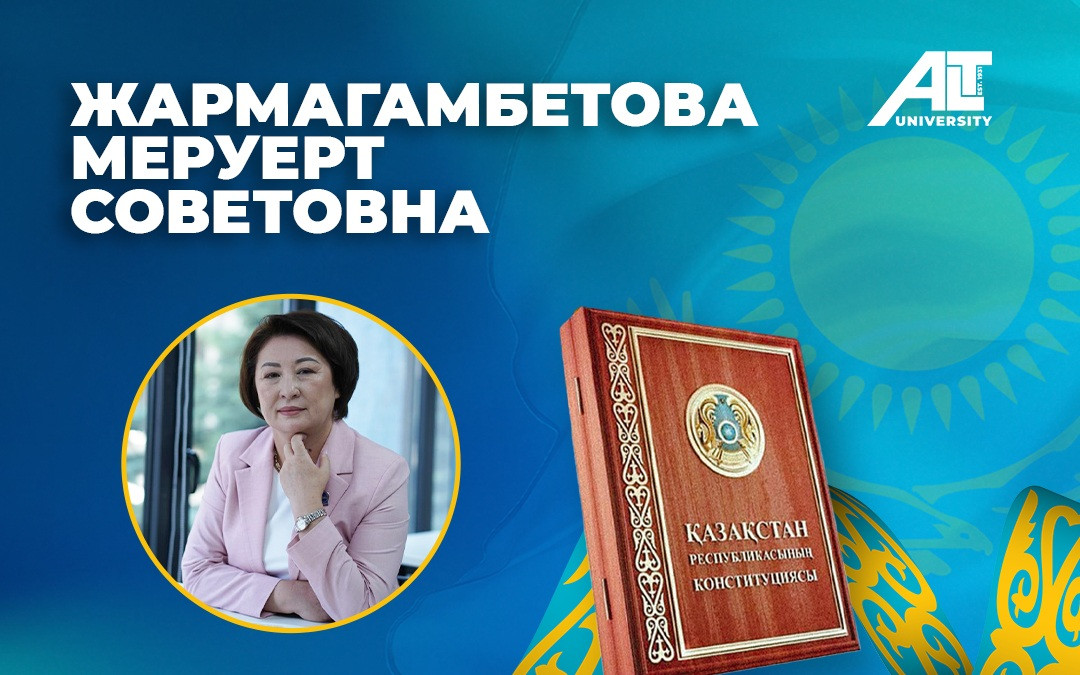
Meruert Sovetovna Zharmagambetova
Chair of the Board – Rector
The draft of the new Constitution of the Republic of Kazakhstan published by the Constitutional Reform Commission marks a transition to a new stage in the development of the country’s state and legal system. It reflects a comprehensive rethinking of the role of the state, the principles of public authority, and the place of the individual within the system of social relations.
The draft Constitution places a strong emphasis on the values of justice, the rule of law, responsibility, and respect for human dignity. These principles form a new political and legal culture in which the state is viewed as a service-oriented and partner-based institution working in the interests of human development.
The value-based framework logically leads to the institutional dimension of the reform. The new Constitution strengthens the principles of accountability, transparency, and balance between branches of power, while expanding mechanisms for citizen participation in public governance. This is particularly important in the context of growing public demand for dialogue, trust, and shared responsibility for the future of the country.
Such an approach requires reliance not only on procedures, but also on the quality of human capital. Therefore, education, science, culture, and innovation occupy a special place in the draft Constitution as strategic resources for development. In effect, the transition is закрепed to a model in which the competitiveness of the state is determined by the level of thinking, knowledge, and responsibility of its citizens.
Within this model, universities become not merely institutions for training professionals, but centers for fostering civic maturity, critical thinking, and the capacity for innovation. In the era of digitalization and artificial intelligence, education emerges as a key factor in ensuring the sustainability of the state.
The architecture of the new Constitution is further complemented by the country’s orientation toward international standards and the United Nations Sustainable Development Goals. This broadens the understanding of development to include not only economic growth and technological progress, but also social justice, inclusion, and environmental responsibility as essential components of quality of life.
In this context, the mission of ALT University — “Creating a better future through education, science, and innovation” — acquires particular significance. This very logic underlies today’s constitutional changes: education becomes a strategic instrument of national development.
We perceive the new Constitution as a framework in which universities receive not only greater responsibility, but also trust — to educate leaders, researchers, engineers, and managers who will shape the Kazakhstan of tomorrow. For us, the core meaning of the reform lies in its focus on the individual, on thinking, and on knowledge as the foundation of a strong, just, and sustainable state.