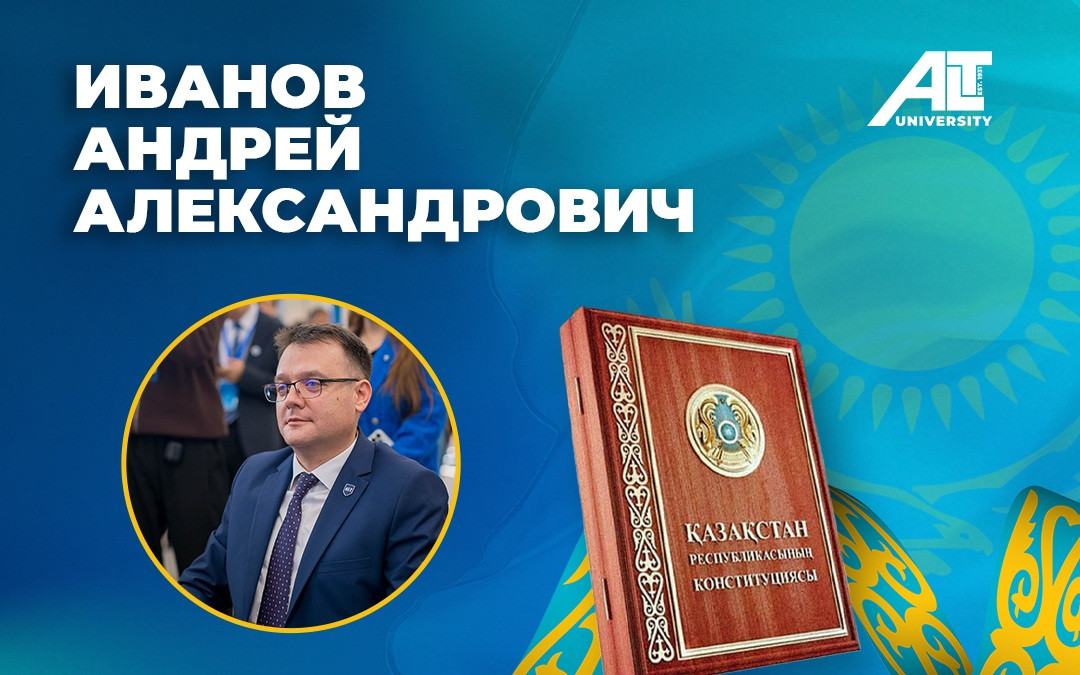
Andrey Alexandrovich Ivanov
Vice Rector for Corporate and Social Development
The draft of the new Constitution of the Republic of Kazakhstan reflects a profound understanding that the country’s sustainability today is determined not only by the strength of state institutions, but also by the quality of social ties, the level of trust between the state and its citizens, and the degree of public engagement in development processes.
The constitutional reform introduces a new philosophy of interaction — a shift from a vertical governance model to a partnership-based approach, where each stakeholder recognizes their responsibility for the shared future.
A strong emphasis is placed on social justice, equal opportunities, and inclusion. The reform aims to create an environment in which every individual, regardless of age, region, or social status, feels involved in a common process and sees real prospects for personal growth.
In this context, universities evolve beyond their traditional educational role to become social hubs — platforms for volunteerism, civic initiatives, corporate social responsibility, and cross-sector partnerships. Increasingly, our work operates at the intersection of education, business, government, and society, fostering an ecosystem of trust and collaborative solutions.
For ALT University, social development is not an abstract concept but a matter of practical action: supporting student communities, developing an inclusive environment, strengthening ties with regions and employers, and participating in social and environmental initiatives. In 2025, ALT University allocated more than 150 million tenge to social support for students and applicants. These funds were distributed through educational grants, tuition discounts, accommodation support in student dormitories, and other targeted assistance measures. This approach not only expands access to education, but also effectively reduces social barriers for talented young people from diverse regions and social backgrounds.
Through such practices, universities foster not only professional competencies, but also social responsibility, teamwork skills, and the ability to understand and respond to societal needs.
Ultimately, the core meaning of the reform lies in building a country where sustainability is ensured through trust, solidarity, and shared values. The Constitution becomes not merely a legal document, but a new-generation social contract in which every citizen, organization, and institution recognizes their role in shaping the future of Kazakhstan.