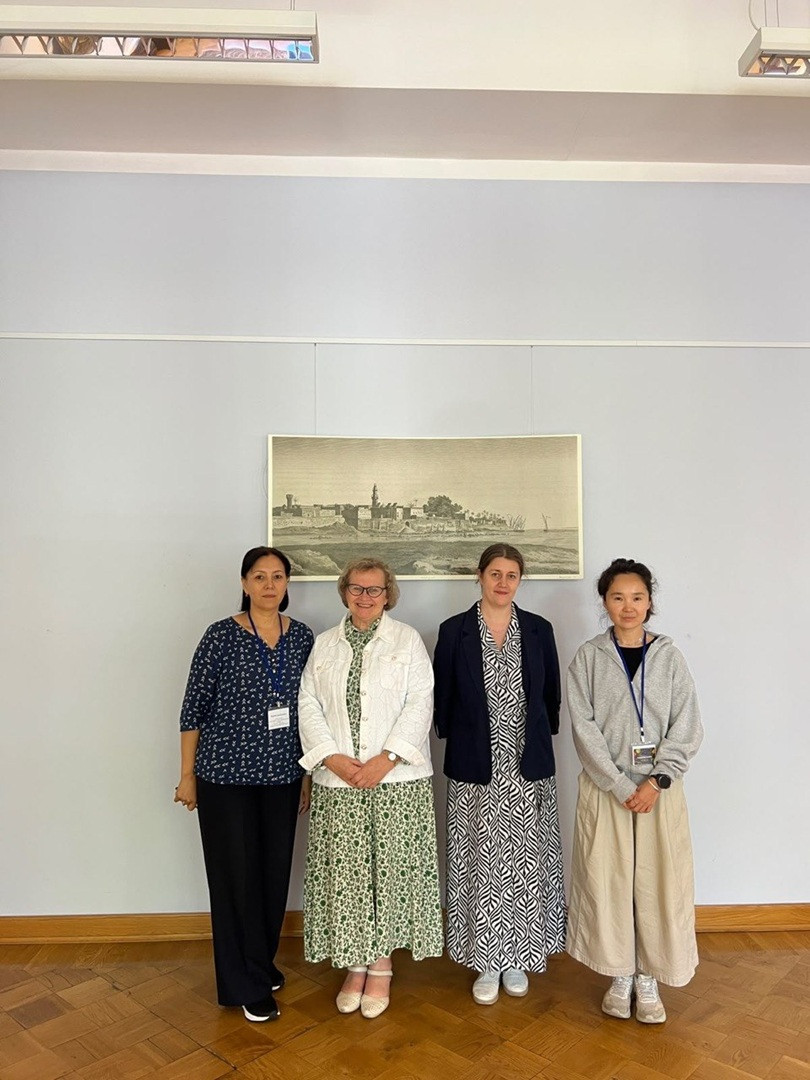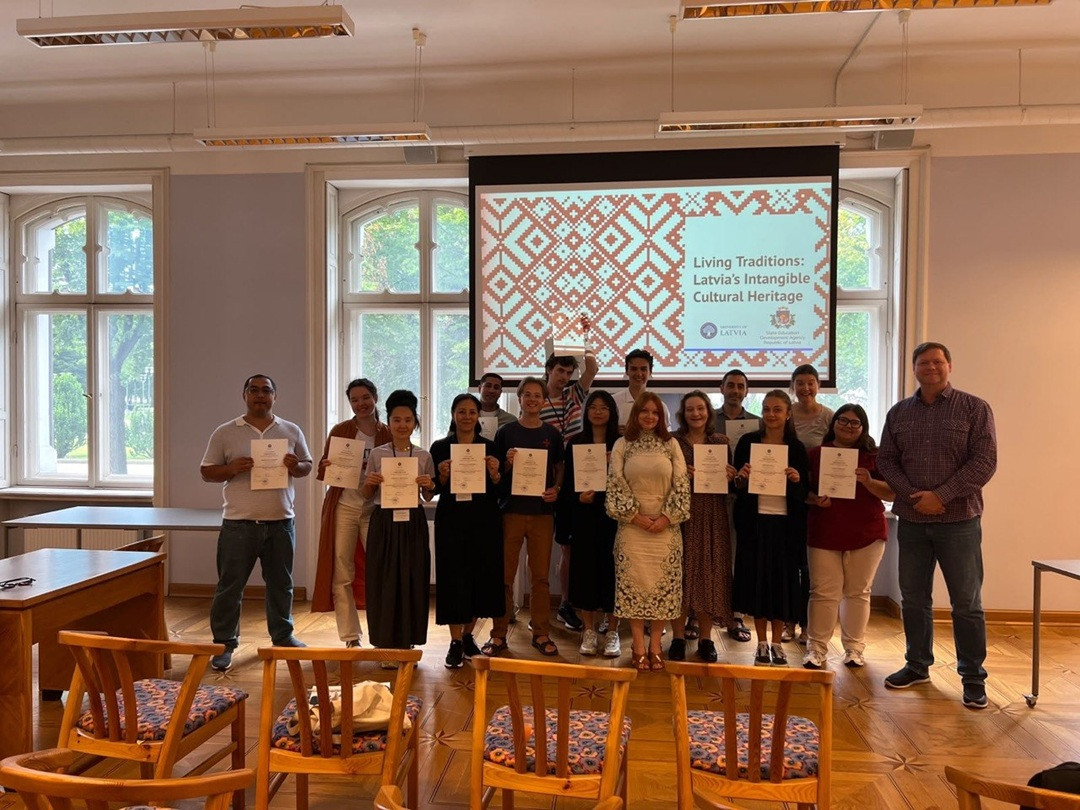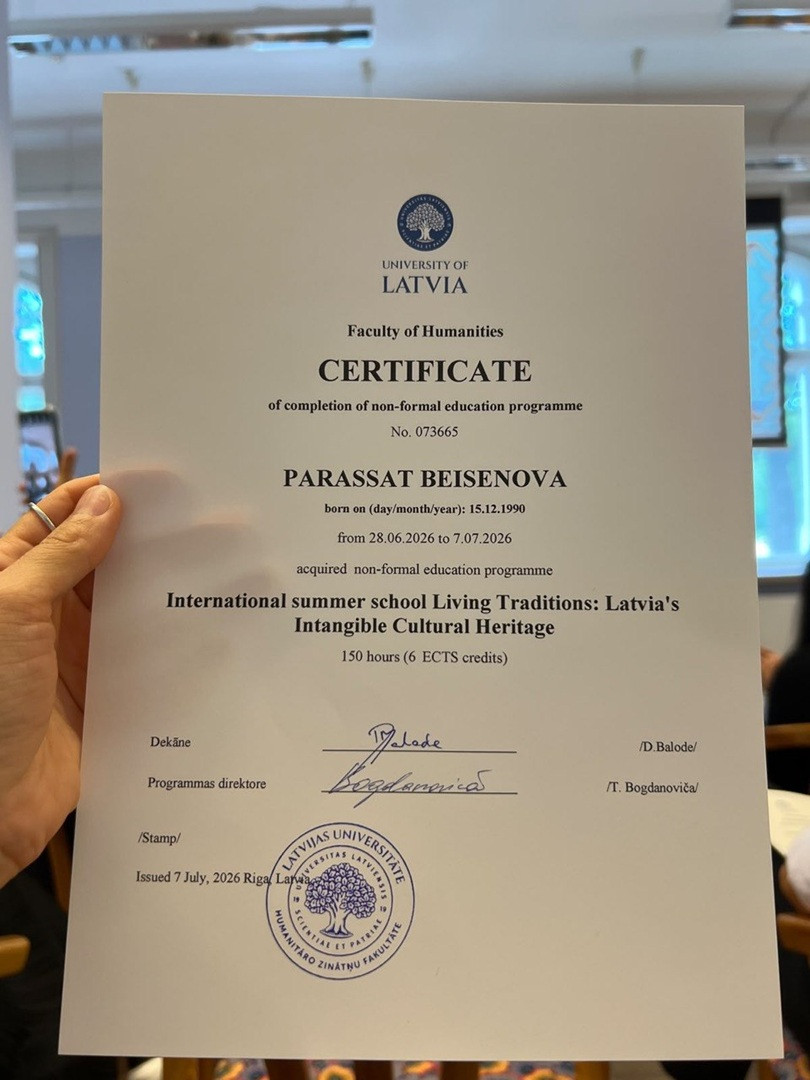
In line with UN Sustainable Development Goal 16 “Peace, Justice, and Strong Institutions,” P.M. Beisenova, Senior Lecturer at the Department of Social and Humanitarian Disciplines and Physical Education, participated in the international summer school “Living Traditions: Latvia’s Intangible Cultural Heritage,” held from June 28 to July 7, 2026, in Riga, Latvia. The program was organized with the support of the State Education Development Agency of Latvia (VIAA) and the University of Latvia.
Following a competitive selection process, the ALT representative was awarded a full scholarship. The program convened researchers from Kazakhstan, the UK, China, Turkey, and European nations for a comprehensive series of lectures, archival research sessions at the Latvian State Historical Archives, and cultural excursions. The summer school served as a sustainable platform for international academic cooperation, highlighting intangible cultural heritage as a vital resource for sustainable development and intercultural dialogue.
Details on the Summer School Program
The summer school program brought together participants from various regions of the world, offering a rich interdisciplinary track that explored the history, culture, and linguistic and religious heritage of Latvia and the Baltic region.
Academic Traditions and Historical Heritage
-
Guided Tour of the University of Latvia Student Dungeons (Karceris):
One of the inaugural events was a visit to the student punishment cell—a state-protected cultural monument. Participants explored student life and academic traditions of the late 19th and early 20th centuries. Special emphasis was placed on the wall drawings and graffiti as unique evidence of the student culture of that era. Between 1875 and 1905, students were incarcerated here for disciplinary infractions: unexcused absences, property damage, insubordination to faculty, participation in academic fencing duels (Mensur), and other offenses. Today, the cells are managed by the university museum, whose specialists continue to research this unique historical site. -
Archival Session at the Latvian State Historical Archives:
A prominent place in the program was assigned to a session titled “Intellectual Heritage: Challenges of Searching and Documenting Historical Memory.” As a structural division of the National Archives of Latvia, it stands as the oldest archival institution in the country, housing over six million documentary items that reflect the political, economic, social, and cultural history of Latvia from 1220 to 1945. Participants examined rare historical documents, including parchment collections, estate and census revision records, church registers, and other primary sources. -
Excursion Through Old Town Riga:
A guided tour of the historic center of the Latvian capital was conducted by researcher and historian Uldis Vanags (Daugavpils University). Participants were introduced to Riga’s architectural landmarks, cultural sites, and urban development history.
Lectures on History and Military Culture
-
“Military Rituals in the Baltic Region during the 13th–14th Centuries” (Vytautas Magnus University):
This lecture examined the military culture of medieval Baltic societies, focusing on martial traditions, rituals, and symbolic practices surrounding armed conflicts. The discussion also addressed the evolution of regional warfare under the influence of Christianization and medieval political shifts. -
“Religious Controversies as a Driving Force of Cultural Development in Former Livonian Lands within the Polish-Lithuanian Commonwealth in the 16th–17th Centuries” (University of Warsaw):
This session explored the impact of confessional dynamics and religious debates on the social and cultural trajectory of the region during the early modern period. -
“Oral History: Interviewing People of the Soviet Era — Complexities of Questionnaire Preparation” (Daugavpils University):
The concluding event of the program focused on oral history methodologies, the specifics of conducting field interviews, and the preservation of individual and collective historical memory.
Ethnography, Folklore, and Religious Traditions
-
“What, How, and Why Do Latvians Believe? Texts, Vernacular Practices, and Worldviews of Latvian Folk Beliefs” (University of Latvia):
Participants gained insights into traditional folk beliefs, folklore, sacred rites, and the spiritual worldview of the Latvian people. -
“Languages and Dialects of Latgale: Baltic and Slavic Intangible Cultural Heritage of a Border Region” (University of Warsaw):
This lecture highlighted the linguistic diversity of Latgale, the historical cross-cultural interactions between Baltic and Slavic communities, and the vital role of local dialects in preserving intangible heritage. -
History and Traditions of Old Believers:
-
Field Visit to the Grebenstchikov Old Believers Community: As a practical extension of the religious studies track, participants visited the community’s museum to learn about the history of Old Belief in Latvia, its religious practices, and the heritage of one of the country’s largest Old Believer congregations.
-
Lecture “The Bride Kidnapping Tradition Among Latvian Old Believers: Origins and Transformation” (Daugavpils University): Researchers analyzed the historical origins of this custom, its social significance, and its evolution over time.
-
Culture, Gastronomy, and Contemporary Design
-
“Food and Drink Culture in Latvia: At the Crossroads of Eras and Peoples” (Daugavpils University, University of Warsaw, Czech Academy of Sciences):
Lecturers analyzed the development of Latvian cuisine, foreign influences on national culinary traditions, and the evolution of dining culture. The session included a tasting of traditional Latvian snacks along with non-alcoholic and alcoholic beverages. -
“Traditional Latvian Ornamentation in Contemporary Latvian Design” (University of Latvia):
This lecture focused on the integration of traditional motifs into modern culture, art, fashion, and design, highlighting creative approaches to preserving national heritage.
Program Outcomes
Through this immersive summer school program, international participants gained valuable interdisciplinary insight, deepened their understanding of Latvia’s historical, linguistic, and religious heritage, engaged with modern methodological frameworks for heritage preservation, and expanded international academic collaboration while fostering intercultural dialogue.